



MAU Series

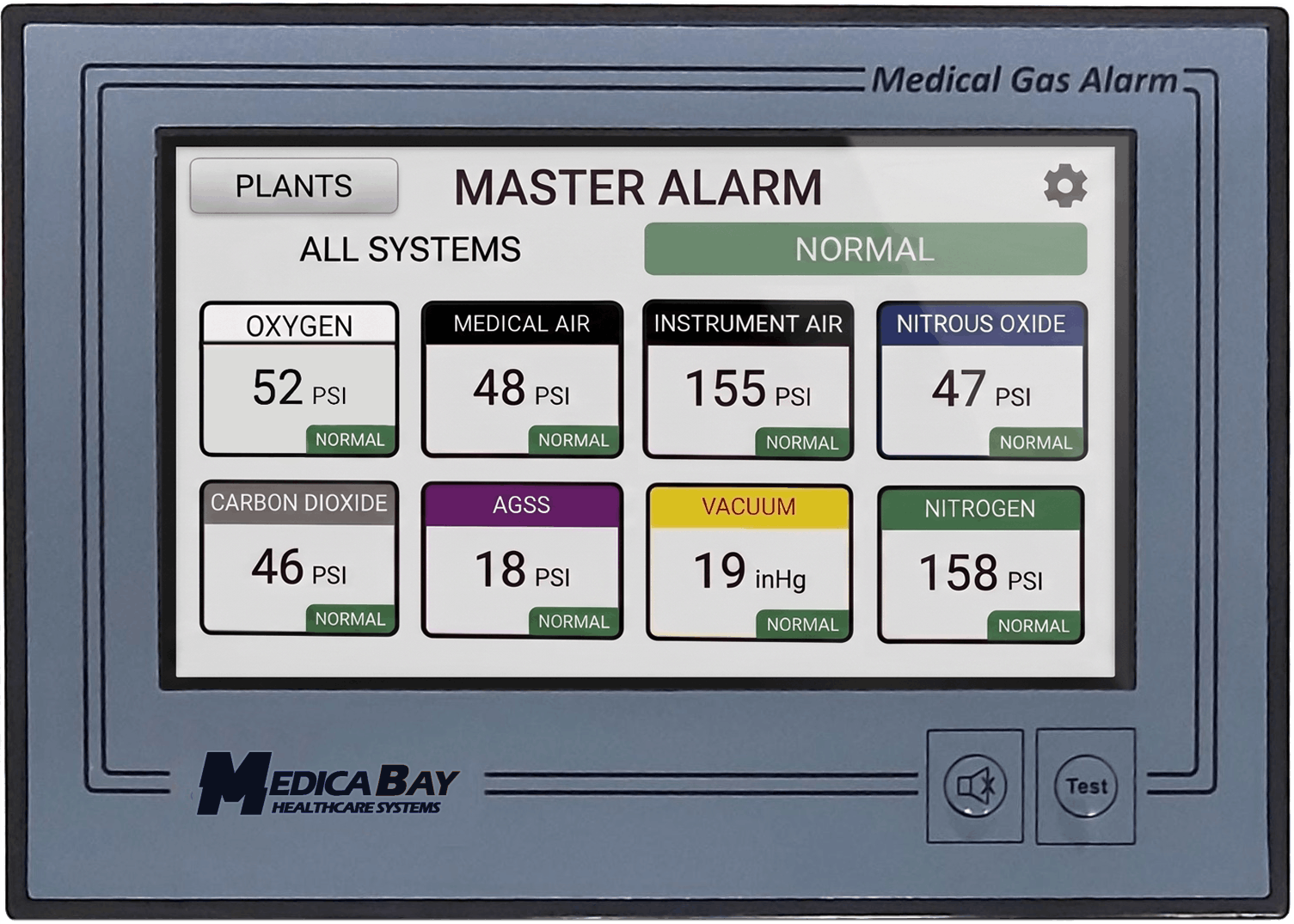
Medicabay Healthcare Systems introduces the Master Alarm Unit, a vital control unit for monitoring medical gas systems. It tracks pressure, flow, and gas levels across oxygen, nitrogen, and carbon dioxide systems. In case of issues like pressure drop or gas leaks, it triggers visual and audible alerts, allowing quick staff response. Built to the highest safety standards, the Master Alarm ensures continuous gas supply and patient safety.
master-alarm-units
Master Alarm Unit

Built for Uninterrupted Healthcare Pipeline Surveillance

Engineered for centralized multi-gas hospital monitoring with intelligent fault discrimination, Building Management System telemetry, and full HTM 02-01 and ISO 7396-1 compliance.

CAPACITY

Up to 48 Channels

Modular inputs monitoring manifold banks, cryogenic tanks, compressor skids, and floor AVSU stations simultaneously.

TELEMETRY

Modbus RS485 & BMS

Daisy-chained industrial serial bus connectivity and volt-free dry contacts for direct SCADA and building automation integration.

ANNUNCIATOR

Digital Screen & Audio

High-resolution digital graphic display screen with muteable acoustic buzzer and automatic re-alarm timer.

ENCLOSURE

Flush & Surface Mount

Heavy-duty DKP steel (RAL 9010) or AISI 304 stainless steel cabinets with key-lock front access for rapid maintenance.

ENGINEERING COMPLIANCE

Built to International Hospital Life-Safety Directives

Medicabay Master Alarm Units are engineered, manufactured, and calibrated in accordance with global medical gas alarm protocols.

PIPELINE DIRECTIVE

ISO 7396-1

Medical Gas Pipeline Systems

Defines mandatory central alarm signal routing, operating pressure monitoring brackets, and priority threshold displays across hospital networks.

CLINICAL ALARM CODE

HTM 02-01

NHS Health Technical Memorandum

Governs clinical visual color indicators, digital screen surveillance, audible alarm sound levels, mute silence delays, and central UPS power connections.

ALARM SYSTEM PROTOCOL

EN 60601-1-8

Medical Electrical Alarm Signals

Regulates audible alarm sound patterns, visual urgency flashing frequencies, and false-alarm prevention algorithms for continuous clinical duty.

QUALITY FRAMEWORK

ISO 13485 & 9001

Medical Device Manufacturing

Every central alarm unit undergoes factory microprocessor testing, circuit insulation validation, and documented telemetry calibration.

Master Alarm Units (MAU Series) Configurator HTM 02-01 • ISO 7396-1 • EN 60601-1-8

Interactive Master Alarm Engineering Matrix

Configure central monitoring channel capacity, heavy-duty cabinet enclosure, and mounting architecture to generate exact catalog order codes, technical parameters, and export tender clauses.

1 Select Monitoring Channel Capacity
8 ChannelsCompact
Floor / Sub-Station Hub
16 ChannelsStandard
Standard Multi-Gas Facility
24 ChannelsHigh-Density
OT & Intensive Care Hub
32 ChannelsEnterprise
Central Monitoring Station
48 ChannelsCampus Hub
Multi-Building Medical Center
2 Cabinet Enclosure Material & Mounting Architecture

Master Alarm Unit (16 Channels)

MAS.MAU.16.RC.EP
Channel Inputs
16 Channels
Visual Display
Digital LCD Screen
Audible Buzzer
Adjustable / Muteable
Enclosure
DKP Steel (RAL 9010)
Mounting
Recessed Flush
Network Bus
Modbus RS485

Engineered for centralized multi-point hospital medical gas surveillance compliant with HTM 02-01, ISO 7396-1, and EN 60601-1-8. Features a multi-channel digital graphic display screen, adjustable acoustic buzzer with temporary mute, built-in Modbus RTU RS485 network bus, and volt-free dry relay contacts for seamless BMS / SCADA integration.


Request Official Quote →

Master Alarm Units FAQs

Essential engineering, telemetry, and clinical compliance answers regarding Medicabay MAU Series central medical gas alarm panels.

What is the primary role of a Master Alarm Unit in a hospital?

A Master Alarm Unit (MAU) serves as the central surveillance hub for the entire hospital medical gas network. It continuously aggregates operational status and fault signals from primary sources (liquid oxygen tanks, manifolds, medical air and vacuum plants) and floor-level Area Valve Service Units (AVSU/ZCU), delivering immediate multi-channel digital screen visualization and acoustic notification to facility managers and clinical engineers.

How do Master Alarm Units receive data from field panels and source plants?

Medicabay Master Alarm Units utilize an integrated Modbus RTU over RS485 industrial serial bus standard. This digital daisy-chained architecture connects multi-floor valve panels and mechanical plant rooms across large hospital campuses over long distances with exceptional noise immunity and minimal cabling overhead.

What is the function of volt-free dry contacts in the alarm panel?

Integrated volt-free dry contacts act as universal fail-safe relay outputs. They allow the Master Alarm Unit to instantly trigger external Building Management Systems (BMS), SCADA control software, central fire stations, or remote auto-dialers during critical medical gas anomalies without requiring third-party protocol converters.

How do alarm sounders comply with hospital acoustic standards?

In strict adherence to HTM 02-01 and ISO 7396-1 pipeline safety directives, the audible annunciator is engineered to deliver clear notification above ambient noise without provoking panic. Sound levels are adjustable, and the unit includes a temporary mute/acknowledge button coupled with an automatic re-alarm timer should the underlying fault condition remain unresolved.

How is electrical power supplied to Master Alarm Units during mains failure?

Medicabay Master Alarm Units are directly connected to the hospital’s central Uninterruptible Power Supply (UPS) network. In strict compliance with HTM 02-01 and ISO 7396-1 healthcare facility safety codes, feeding through the central medical UPS line guarantees continuous, fail-safe 24/7 digital screen surveillance and acoustic alarm operation without interruption during main grid power outages.

Complete the hospital gas pipeline network

Interconnected medical gas source plants, local emergency cabinets, and terminal units from one engineering manufacturer.

Scroll to Top