



Medical Gas Systems • PulOx PSA Series

Oxygen Generating Plant

MEDICABAY, through its PULOX range, offers advanced and reliable medical oxygen generation solutions designed to meet the demanding requirements of modern healthcare facilities. Utilizing optimized Pressure Swing Adsorption (PSA) technology, PULOX oxygen generators ensure high operational efficiency, reliability, and continuous oxygen supply. Designed for hospitals, including facilities with surgical departments and intensive care units, PULOX systems produce medical oxygen with a stable purity of 95% ± 2%, ensuring consistent performance and dependable operation.

MGS.PSA.G0400 PSA Generator Model
24 m³/h Rated flow
37 kW Air compressor
1,000 L Oxygen receiver

Size to peak demand of all outlets. Our engineers will check your figure.
ISO 7396-1 Pipeline Safety Standard
ISO 13485 Medical Quality Management
FAT Tested Factory Acceptance Test 100%
Oxygen Generating Plant
Automation & Reliability

Built to run unattended

8 engineering layers ensuring continuous, autonomous medical oxygen production with zero day-to-day intervention.

01

Automatic operation

The plant starts and stops with demand, so oxygen is available around the clock.

02

Touchscreen panel

Live readings and data logging at the plant, in a plain operator interface.

03

Remote access, Modbus TCP/IP

Optional online monitoring and connection to SCADA or PLC platforms.

04

Purity watched all the time

An oxygen analyzer and PLC keep the output inside its set purity limits.

05

Clean compressed air

Air supply to the Pressure Swing Adsorption Plants meets ISO 8573-1:2010 class 2.4.1 for stable operation.

06

Low-service exhaust

European-made valves and exhaust parts are chosen to keep service visits few.

07

Modular and scalable

Capacity and configuration are set to your facility and can be extended.

08

Higher purity or tonnage

Optional VPSA and cryogenic systems cover higher purity and large-scale needs.

Installation Formats

Built to your site

Every PULOX plant is built to order. Hospitals usually ask for a skid-mounted plant that goes into a plant room. Mobile and field hospitals usually ask for a containerized plant. Tell us the site and we configure it.
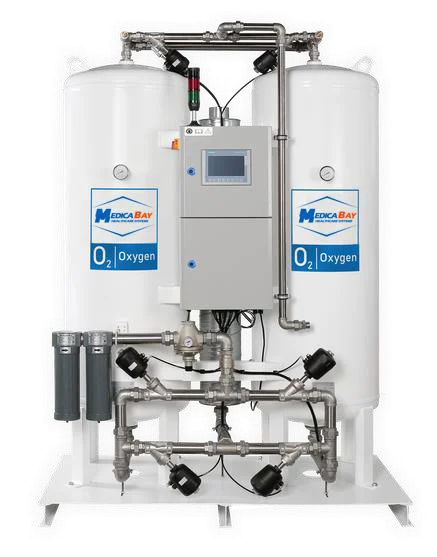
On-site mounted oxygen plant

On-site mounted plant

A compact and organized solution for permanent hospital buildings and prepared plant rooms.

  • Typical for hospitals and permanent healthcare buildings
  • For a clean, heated and ventilated plant room
  • PSA unit, filters, valves and control panel on one frame
  • Touchscreen panel with optional remote access
  • Ambient operating range: +5 to +40 °C
  • Skid dimensions, lifting points and installation clearances
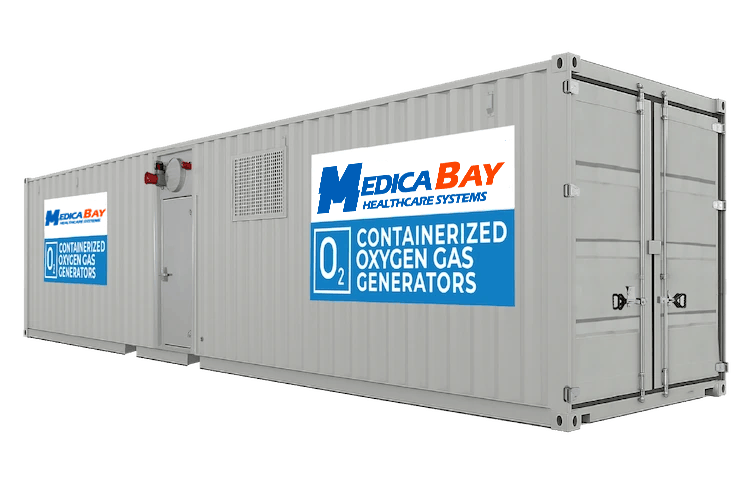
Containerized oxygen generating plant

Containerized plant

A protected and deployable solution for mobile hospitals, field hospitals and sites without a dedicated plant room.

  • Typical for mobile, field and temporary hospitals
  • For sites with no plant room or fast deployment requirements
  • Optional ambient range: −50 to +60 °C
  • Container size, insulation, HVAC and CSC plate
  • Factory-assembled system for simplified site installation
  • Optional remote monitoring and plant status connection
Final format selection depends on the site conditions, local climate, available electrical supply, ventilation requirements, transport access and the selected oxygen capacity.
Principle of Operation

How PSA makes oxygen

Zeolite beds take turns. One makes oxygen while the other is cleaned, so the output never stops.

Tower A zeolite bed Tower B zeolite bed O₂ % Purity Sensor 95% ± 2% Analyzer Dry compressed air in (21 % O₂) Oxygen to the receiver (up to 95 %) Nitrogen out Nitrogen out
Compressed air Oxygen Released nitrogen Filled valve = open O₂ Sensor Active

Continuous Dual-Bed Cycle

Ambient air holds about 21 % oxygen. It is compressed, dried and filtered, then rises through a tower of zeolite molecular sieve. The zeolite holds back nitrogen, so the oxygen share rises to the purity the hospital needs, and the oxygen passes on to the receiver tank.

Adsorption Phase Under pressure, synthetic zeolite captures nitrogen while medical oxygen flows forward.
Desorption Phase The idle bed depressurizes to exhaust the trapped nitrogen with no chemicals involved.
Online Purity Monitoring An integrated paramagnetic or zirconia O₂ sensor continuously validates output purity before pipeline delivery.
  • The oxygen analyzer measures purity continuously during production.
  • The PLC adjusts the cycle to demand and keeps output within tight limits.
  • Zeolite regenerates automatically, guaranteeing non-stop 24/7 supply.
See backup and supply layouts
Plant Architecture

What is in the plant

The PULOX medical oxygen generation system combines compressed-air preparation, filtration, PSA oxygen generation and oxygen storage in one complete plant.
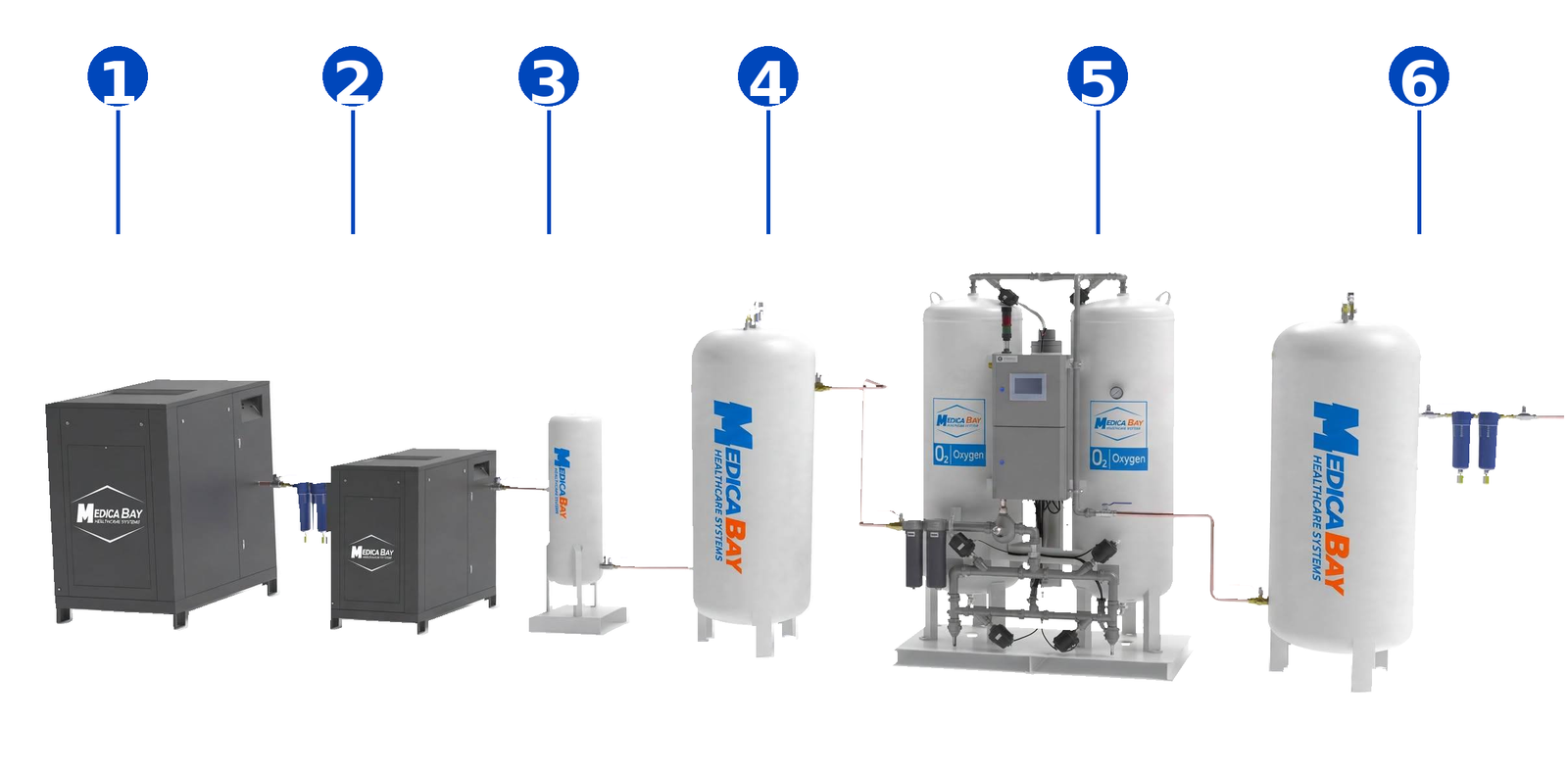
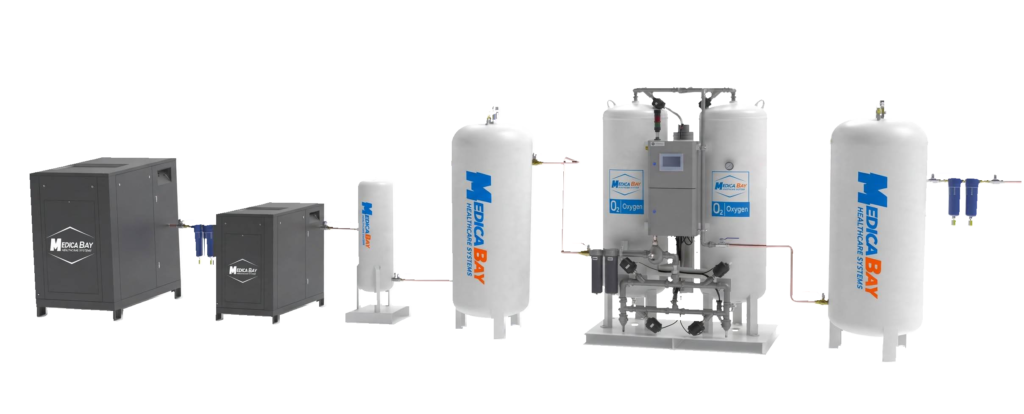
PULOX medical oxygen plant showing air compressor, dryer, activated carbon tower, air tank, pressure swing adsorption plant and oxygen tank
  1. 1
    Air Compressor Supplies compressed ambient air to the oxygen generation system.
  2. 2
    Dryer Removes moisture from the compressed air before filtration and PSA processing.
  3. 3
    Activated Carbon Tower Helps remove oil vapour and hydrocarbon impurities from the compressed air.
  4. 4
    Air Tank Stores conditioned compressed air and helps stabilize the plant inlet flow.
  5. 5
    Pressure Swing Adsorption Plant Uses zeolite molecular sieve beds to separate nitrogen from oxygen.
  6. 6
    Oxygen Tank Receives and stores product oxygen before delivery to the hospital pipeline.

The exact equipment arrangement may vary according to the selected capacity, oxygen purity, receiver volume and project configuration.

Compliance & Redundancy

Supply layouts to HTM 02-01

HTM 02-01 treats the PSA plant as the primary supply and requires a secondary supply that starts automatically. These layouts follow its structure for PSA plants.

PSA oxygen plantwith analysers Emergencyreserve manifold plant stops Hospital pipeline

Primary PSA with reserve manifold

The oxygen analysers are part of the PSA plant. If purity falls below 94 %, the plant stops producing and the emergency reserve manifold takes over automatically. The reserve is sited apart from the plant, with its own route into the pipeline. HTM 02-01 §2.32, 6.31, 6.122.

Duplexcompressors Duplex dryersand filters Sieve bedsA and B Oxygenreceiver Duplex O₂analysers PLC and plant statusto building management To pipeline

Inside the PSA plant

Duplex compressors, duplex filters and dryers, duplex sieve towers and duplex oxygen analysers, so no single component failure stops the supply. HTM 02-01 §6.116, 6.121.

PSA oxygen plantwith analysers Receivingtank Booster andfilling ramp Reservecylinders Hospital pipeline

With cylinder filling

An optional booster and filling ramp fill cylinders from the plant. Reserve cylinders must match the plant oxygen concentration. HTM 02-01 §6.112.

Plant status connects to the building management system for monitoring only, and all plant components sit on the essential electrical supply (HTM 02-01 §6.126, 6.132). Reserve sources: Automatic Manifold Plant and Oxygen Filling Plant.

Quality & Certification

Standards we build to

PULOX plants are designed and manufactured in line with these references. Our engineering and testing process is aligned with the requirements of medical oxygen plant projects.

ReferenceWhat it covers
ISO ISO 7396-1Medical gas pipeline systems
HTM HTM 02-01Medical gas pipeline systems, design and installation guidance
NFPA NFPA 99Health care facilities and medical gas systems
ISO ISO 13485Quality management for medical devices
FAT Factory Acceptance TestEvery plant is tested before dispatch
01
Medical gas compliance Plant design is prepared for medical oxygen applications.
02
Quality-controlled manufacturing Manufacturing and documentation follow controlled quality procedures.
03
Factory testing Oxygen purity, flow and pressure are checked before dispatch.
04
Project-specific engineering Final configuration is adapted to the required capacity and site.

The applicable standards and project requirements should be confirmed against the final tender, local regulations and the destination country's healthcare standards.

Plant Sizing & Specifications • ISO 7396-1 • ISO 13485

Choose a model by flow

PULOX medical oxygen producing plants run from 3 to 120 m³/h in 24 models. Set capacity range, model, purity and receiving tank, then request a quotation or copy the tender clause.

ModelOxygen flow (m³/h)Air compressor (HP / kW)Air dryer (kW)Oxygen receiver (L)Purity (%)Outlet (bar)Dew point (°C)Oil (mg/m³)Compressor kW per m³/h

MGS.PSA.G0400

Oxygen flow
24 m³/h
Purity
95 ± 2 %
Outlet pressure
4–6 bar
Air compressor
37 kW
Air dryer
1.44 kW
Oxygen receiver
1,000 L

The model table lists 95 ± 2 % for every model. The 93 ± 2 % option is selectable in the builder.


Knowledge Base & Specifications

Frequently Asked Questions

Engineering specifications, compliance standards, and sizing guidance for PULOX medical oxygen generation systems.

What oxygen purity and outlet pressure does the PSA Oxygen Generator deliver?

Medicabay PSA Oxygen Generator units produce medical-grade oxygen with 93% ± 2% or 95% ± 2% purity at a stable outlet pressure of 4.0 to 6.0 bar. Purity is continuously monitored by an onboard paramagnetic analyzer with automated purge and acoustic/visual alarms to ensure only pharmacopoeia-grade gas enters the hospital line.

Which international standards govern Medical Oxygen Generating Plants?

All Medicabay Medical Oxygen Generating Plants are designed, manufactured and tested in full compliance with ISO 7396-1:2016, ISO 13485:2016 (Medical Devices QMS), European Pharmacopoeia, and NHS HTM 02-01 Part A specifications. Full Factory Acceptance Testing (FAT) documentation is supplied with every plant.

How do Pressure Swing Adsorption Plants integrate with hospital backup supplies?

In accordance with HTM 02-01 and ISO 7396-1 safety regulations, Pressure Swing Adsorption Plants serve as primary or secondary supply sources and are paired with an automatic change-over cylinder manifold or liquid cryogenic tank as an emergency reserve. If pipeline pressure drops or oxygen purity deviates, the system automatically triggers seamless switchover to the backup source.

When should healthcare facilities choose skid-mounted vs containerized Oxygen Producing Plants?

Skid-mounted Oxygen Producing Plants are engineered for indoor hospital plant rooms, providing a compact footprint with easy routine maintenance. For facilities without dedicated indoor plant space, or for remote and mobile field hospitals, our weatherproof, climate-controlled containerized plants arrive pre-piped and pre-wired for rapid turnkey commissioning.

What are the operating costs and zeolite sieve lifespan of an Oxygen Generating Plant?

Operating an on-site Oxygen Generating Plant reduces hospital medical oxygen costs by 65% to 80% compared to delivered cryogenic liquid or high-pressure cylinders. The high-efficiency Lithium-Zeolite molecular sieve (ZMS) provides an operational lifespan exceeding 10 to 12 years when supplied with dry, oil-free compressed air according to ISO 8573-1 Class 1.4.1.

Can the Oxygen Generating Plant be monitored remotely via hospital BMS / SCADA?

Yes. Every plant features a Siemens or Beckhoff touchscreen PLC equipped with Modbus TCP/IP and RS485 communication protocols. Real-time telemetry—including oxygen flow rate (m³/h), purity (%), line pressure (bar), and dew point—can be streamed directly to the central hospital control room.

Choose the Perfect Capacity for Your Needs

Easily find the capacity that best fits your requirements by reviewing the table below. We offer a range of options designed to meet diverse needs with maximum efficiency and reliability. Once you’ve identified the ideal capacity, don’t hesitate to reach out to us for more information, personalized assistance, or a detailed quote.

Contact us via the email provided below—we’re here to support you every step of the way!

Scroll to Top