


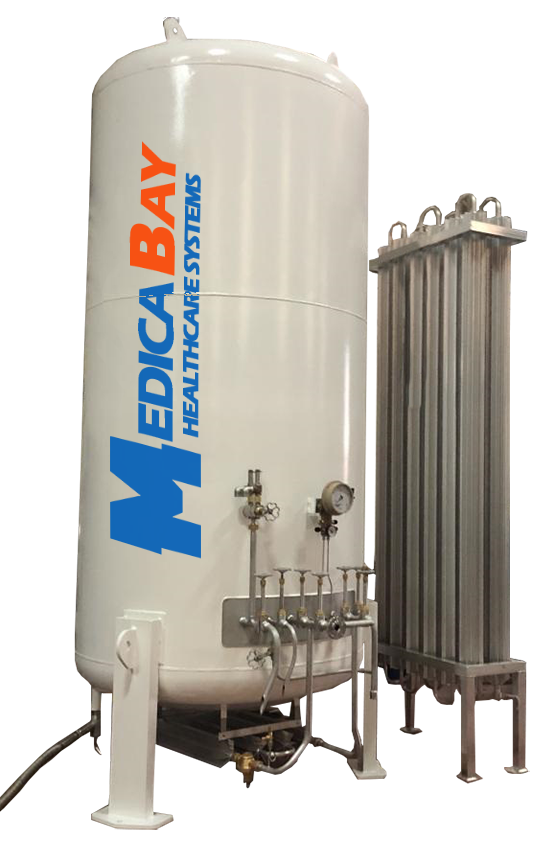
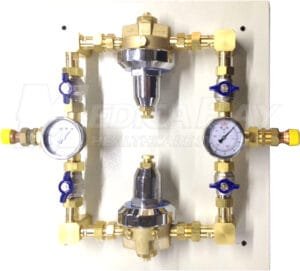
High-performance Cryogenic Oxygen Tank and Vacuum Insulated Evaporator (VIE) systems engineered for centralized hospital medical liquid oxygen storage. Vertical double-walled perlite vacuum vessels from 3,000 to 50,000 Liters, operating at 16 or 37 bar working pressures with dual continuous ambient convection vaporizers and automated pressure regulating manifolds compliant with ISO 7396-1 and HTM 02-01. Every VIE oxygen system is customized for hospital bulk consumption and peak-flow reliability.
Liquid expands 860:1 into gas. Sizing based on EN 13458 and HTM 02-01 diversity factor.
Table of Contents
Built to run unattended
Automated cryogenic pressure regulation, dual ambient vaporization, and remote telemetry transmission deliver continuous medical oxygen without manual intervention.
Continuous Gasification
Natural ambient air convection finned vaporizers convert liquid into gas utilizing atmospheric heat with zero electrical power required.
Self-Sustaining Pressure
The integrated pressure building coil vaporizes a small volume of liquid to maintain header pipeline pressure automatically during peak draw.
Economizer Boil-Off Control
Directs natural headspace vapor boil-off straight into the hospital pipeline before liquid extraction, eliminating vented gas waste.
Digital Telemetry & Level
Differential pressure level transmitters output 4–20 mA signals to hospital BMS/SCADA platforms for continuous central level and pressure monitoring.
Dual Safety Relief System
Redundant dual safety relief valves with 3-way diverter blocks and rupture discs permit valve inspection without tank depressurization.
Clean Medical Oxygen
Austenitic stainless steel inner vessel degreased and sanitized specifically for medical oxygen service according to EN 13458 and ISO 7396-1.
Compound Site Security
Engineered perimeter layout includes emergency shut-off valves (ESV), anti-static tanker grounding, and safety thermal relief loops.
Reserve Manifold Tie-In
Direct seamless tie-in to automatic high-pressure cylinder reserve manifolds, satisfying HTM 02-01 three-source system security.
How cryogenic storage works
Medical oxygen liquefies at -183 °C. Under high vacuum perlite insulation, 1 Liter of liquid expands into 860 Liters of gaseous medical oxygen at atmospheric temperature and pipeline pressure.
What is in the plant
Supply layouts to HTM 02-01
HTM 02-01 and ISO 7396-1 require primary, secondary, and reserve medical oxygen sources. VIE cryogenic bulk storage forms the core supply in acute healthcare infrastructure.
Primary VIE with Reserve Manifold
The standard hospital layout. The bulk VIE tank provides primary flow through dual vaporizers. An automatic high-pressure cylinder reserve manifold acts as secondary supply if vessel pressure drops or during refilling. Compliant with HTM 02-01 §2.32 & §6.31.
Dual VIE System (Primary + Secondary Tank)
Designed for major university hospitals and regional trauma centers exceeding 1,000 Nm³/h draw. Two cryogenic tanks operate with automatic changeover so either vessel can support the entire hospital independently during maintenance or tanker refilling. HTM 02-01 §6.34.
Hybrid VIE + On-Site PSA Generation
The highest efficiency configuration. An on-site PULOX PSA oxygen generator supplies continuous baseline hospital consumption at minimal operating cost, while the Liquid Oxygen Tank handles surge peaks and provides weeks of bulk emergency reserve. ISO 7396-1 §5.5.
Standards we build to
Medicabay Vacuum Insulated Evaporator vessels, Cryogenic Oxygen Tank installations, and pressure regulating systems are designed, fabricated, and tested in accordance with European and international pressure vessel directives.
| Reference | What it covers |
|---|---|
| EN EN 13458-1/2/3 | Cryogenic vessels — Static vacuum-insulated vessels (design, fabrication, inspection, and operation) |
| PED PED 2014/68/EU | European Pressure Equipment Directive Module H/H1 CE 2195 certified quality assurance |
| ASME ASME BPVC Sec VIII | Rules for construction of pressure vessels Division 1 cryogenic service |
| ISO ISO 7396-1:2016 | Medical gas pipeline systems — Part 1: Pipeline systems for compressed medical gases and vacuum |
| HTM HTM 02-01 Part A | NHS England Health Technical Memorandum — VIE cryogenic bulk liquid oxygen storage and supply systems |
| NFPA NFPA 99 | Health Care Facilities Code — Bulk oxygen supply systems, foundation siting, and safety distances |
Liquid Oxygen Tank Builder EN 13458 • PED 2014/68/EU • ISO 7396-1
Choose a model by volume & capacity
Medicabay MGS.LOX series vertical cryogenic tanks range from 3,000 to 50,000 Liters, with 16 bar standard operating pressure, matched with dual continuous ambient convection vaporizers.
| Model | Gross Volume | Design Pressure | Gas Equivalent | Vaporizer Flow | Daily Boil-Off | Dimensions (H×Dia) | Empty Weight |
|---|
MGS.LOX.T0010
- Gaseous Oxygen Yield
- 8,600,000 Liters
- Hospital Bed Coverage
- 120–250 Acute Beds
- Recommended Vaporizer
- 400 Nm³/h (Dual Bank)
- Design Pressure
- 16 bar (Standard)
- Daily Boil-Off Rate
- < 0.28% / 24h
- Dimensions (H × Dia)
- 6,800 × 2,000 mm
All models comply with EN 13458, PED 2014/68/EU Module H/H1, and ISO 7396-1. Dual 100% ambient vaporizers are factory matched to ensure continuous uninterrupted defrost changeover.
Frequently Asked Questions
Key engineering, safety, and procurement guidance on hospital Liquid Oxygen Tank (VIE) systems, vaporizer sizing, boil-off management, and HTM 02-01 compliance.
How does a Vacuum Insulated Evaporator (VIE) Cryogenic Oxygen Tank supply hospital pipelines?
Cryogenic liquid oxygen is stored inside an austenitic stainless steel inner vessel at -183 °C insulated by a high-vacuum perlite annular space. When medical gas is consumed by hospital wards, liquid flows through automatic withdrawal valves into external multi-fin aluminum ambient vaporizers. Atmospheric heat vaporizes the cryogenic liquid into gaseous oxygen, which then passes through a dual-line pressure reduction station regulating final pipeline supply at 4.0 to 5.0 bar, in full compliance with ISO 7396-1:2016.
Why is 16 bar the standard working pressure for hospital VIE tanks?
16 bar is the internationally accepted working pressure for hospital-grade Vacuum Insulated Evaporators because it provides ample margin above the 4.0–5.0 bar medical pipeline delivery pressure while keeping vessel wall thickness, weight, and cost within practical limits. A dual-line pressure reduction station steps the 16 bar tank pressure down to pipeline header pressure in strict compliance with ISO 7396-1:2016 and NHS England HTM 02-01. This pressure rating covers the vast majority of acute hospital bed capacities and campus pipeline lengths without requiring heavier, more expensive high-pressure vessel construction.
Why are dual ambient vaporizers required by ISO 7396-1 and HTM 02-01?
Continuous cryogenic gasification cools the aluminum heat exchange fins below freezing, causing atmospheric humidity to condense and freeze onto the outer surfaces. Over time, frost accumulation acts as an insulator, reducing heat transfer efficiency. Under ISO 7396-1 and NHS England HTM 02-01 Part A, two independent 100% capacity vaporizer banks are strictly mandated. An automated 8-hour changeover timer or differential pressure controller alternates the flow so that one vaporizer bank defrosts naturally while the other maintains uninterrupted hospital gas supply.
What is the normal boil-off rate and how does the economizer circuit save gas?
Natural ambient thermal ingress results in a minor daily boil-off rate (< 0.15% to 0.42% of gross tank volume per 24 hours). Medicabay tanks incorporate an automated Economizer Circuit that preferentially routes natural headspace boil-off vapor directly into the hospital pipeline before liquid is withdrawn. This keeps vessel pressure within safe operating limits and completely eliminates vented gas loss during routine hospital operation.
What compound safety clearances and foundation civil works are required?
Cryogenic liquid oxygen installations require an outdoor fenced security compound with minimum safety distances (5 to 10 meters depending on NFPA 99 and HTM 02-01) from combustible materials, open drains, building ventilation intakes, and road transit areas. A dedicated reinforced concrete foundation pad engineered for full flooded cryogenic vessel weight, seismic acceleration, and local wind loads is mandatory.
Can a Liquid Oxygen Tank be combined with on-site PSA Oxygen Generators and Filling Plants?
Yes. Medicabay specializes in hybrid medical gas infrastructure where an on-site PULOX PSA Oxygen Generator provides continuous base consumption at minimal cost, while the Liquid Oxygen Tank functions as the secondary bulk supply and emergency reserve. Any excess generated oxygen can also be diverted to an on-site Oxygen Filling Plant for high-pressure cylinder backup.
Complete the gas supply
The rest of the source equipment, from one manufacturer.
Choose the Perfect Capacity for Your Needs
Easily find the capacity that best fits your requirements by reviewing the table below. We offer a range of options designed to meet diverse needs with maximum efficiency and reliability. Once you’ve identified the ideal capacity, don’t hesitate to reach out to us for more information, personalized assistance, or a detailed quote.
Contact us via the email provided below—we’re here to support you every step of the way!